Tuesday, January 28, 2014

On parenting.

Now, I don’t have children, so I don’t necessarily understand all the nuances of child-rearing, but having worked as a high school teacher for the past three years, I think I’ve earned the right to say what I think about the relevance of proper parenting. On a daily basis, I manage classrooms of 30+ students, most of whom cannot write a proper essay or listen long enough to hear the instructions. I cannot tell you how many times a student will ask me what he or she is supposed to be doing, 30 seconds after I finish explaining what he or she is supposed to be doing. Literally 30 seconds. So here is some parenting advice from an I-am-in-danger-of-romanticizing-the-1950’s-era-of-male-emotional-stoicism-and-female-housewife-suppression-because-at-least-our-kids-knew-how-to-read teacher: 
  1. Teach your children to read books. Put away the video games, limit their time on the computer and please confiscate the smartphone if your child or teenager spends more time on it than with you. If you instill in your children the value of the well-written word, they will learn how to think critically, to read between the lines, and to comprehend human interaction and emotional depth. If I need to explain the importance of these things to you, then there’s no point in your reading any further, because there’s really nothing I could say that would make you understand.
  2. Teach your children boundaries and respect. This is NOT the school’s job. We already have enough to deal with. As my parents told me many times growing up, if you don’t learn to control yourself, then someone else will control you. If you have any knowledge or understanding of history and human nature, then you’ll get why this is a useful guideline. Pass it on. 
  3. Teach your children the concept of RESPONSIBILITY and the virtue of PREPARATION. As in: Bring a pen to class. Memorize those verb conjugations. Save the project on a USB - because everybody knows your computer is going to die on the day of your presentation. Facts of life, people. Facts of life. The real world can be pretty cutthroat. We’re not doing them any favors by handing everything to them on a silver platter. I am not in the customer service business. 
  4. Don’t allow an ADHD diagnosis to let you off the hook when it comes to you parental responsibility. Medication is not going to curb your child - you are. These types of kids can grow up to be creative powerhouses - IF they learn how to channel their gifts constructively. I’m well aware that this requires a TON of mental and emotional energy, but think of how much easier you’ll be making my life. 
  5. Please do the world this favor: Don’t surrender your authority that easily. Once you lose it, it’s pretty much impossible to get it back. 
Yes, I’m venting. But I am genuinely concerned about the future of our young people, and with them, the world. With all the technological advances of our day and age, we’re at the point of no return. We cannot afford to let computers raise our kids. We cannot afford to shift our parental responsibility onto another person or institution. If all your children receive from you are whatever tired bread crumbs you’ve got left by the time evening rolls around, then may I kindly suggest a restructuring of priorities. On behalf of teachers and future employers everywhere, I thank you. 

Thursday, December 19, 2013

On the nature of peace, pacifism and war.

Nobody asked me for my opinion on this subject, but here it is anyway. I spent Friday night watching the Nobel Peace Prize concert held in Oslo every year. Before I moved to Sweden I didn’t even know there was such a concert, but now I’ve made it my annual tradition. It’s always inspiring to hear the winners speak of their efforts to promote human dignity and call for an end to war. And the music isn’t bad either. I get swept up in the emotion of it all, the noble words, the grand ideals. Peace is a really lovely thought, as it serves to bring people together - sometimes permanently, most of the time temporarily. I say this because peace, as we’ve come to define it, is a fleeting emotion more than it is a livable reality. Once the romance wears off, we’re left with the commitment part of the relationship. And that’s the part that often sucks. 

I read a very interesting op ed piece the other day that got me thinking about the nature of pacifism. The article questioned the world’s choosing to exclusively remember Nelson Mandela as forgiving, reconciliatory, and pacifistic. Many forget that Mandela was, during his pre-Robben Island years, an advocate for violence as a means to fight injustice. It was only after he was released from prison that he became the spokesman for forgiveness and reconciliation in his nation’s fight against apartheid. The author poses the very interesting question of whether Mandela’s years of peace were only made possible by his years of violence. (If you understand Swedish, you can read the op ed here: http://mobil.dn.se/kultur-noje/kulturdebatt/kajsa-ekis-ekman-bilden-av-pacifisten-mandela-ar-djupt-hycklande/?brs=d.)

Here’s the thing: I don’t think pacifism actually works as an ideology. Or maybe it only works when it’s predicated on war. As in: Now that we’ve torn each other to shreds, we can find within ourselves the generosity, compromise and diplomacy needed to sort out the mess. 

I would argue that struggle, and the instinct to fight against other human beings, is just as ingrained in us as the instinct to seek love and shelter. If the struggle isn’t physically against each other, it’s against oppression, corruption and disillusion. And ultimately, I would argue, it’s against God. We are oppressed because we haven’t learned to control ourselves and are therefore controlled by others. We are corrupt because we can’t handle power. We are disillusioned because life never turns out the way we plan. And we fight against God because we fear the idea of not having ultimate control over our own destinies. We can talk peace and pacifism all we want, but truth is that violence and rebellion are in our nature. 

I don’t actively advocate violence as the solution to a problem. It’s not healthy and it’s not practical. Nevertheless, I do think that violence and/or war is a necessary evil at times. Not only because it helps decide the outcome of an issue that is diplomatically unresolvable, but also because war brings people together in a way that peace doesn’t. War requires a very intense recalculation of one’s priorities, and complex decisions become simpler somehow. It also creates an aftermath in which we can grieve, forgive and rebuild. Pacifism just keeps everything churning under the surface without really allowing confrontation and release to happen. 

Who was it that said ”All is fair in love and war?” Whoever it was, the person certainly had insight into the human condition. On a micro scale, everything about love and war is unfair. But on a macro scale, when human history is viewed holistically from beginning to end, I do believe there is truth in that statement. 

Tuesday, December 10, 2013

Cultural differences: Episode 1

I’ve lived in four different countries and often find myself comparing the characteristics of their people in my head. As in, what would a Swede do in this situation as opposed to a Spaniard? Anyway, last Sunday at church we sectioned off the back rows with tape so as to force people to fill the sanctuary from the front (Swedes don’t much like sitting in the front rows of any room). I half expected complaints, but none arose and people obediently did as they were ”told.” So I started this mental comparison and it became kind of a comical short film in my head: 

As mentioned, the average Swede would, when encountering a blocked row or a reserved seat, continue on, after a split second of looking dazed and confused, to another row without verbalizing any question or disagreement. They may not understand the reason, but unless asked, they won’t bring it up. 

A Spaniard would stop, survey the situation, then subsequently start complaining to their companions, under their breath at first; then, as in ripple effect, the noise level would grow as the entire group gets disgruntled and starts questioning the unfairness and unreasonableness of it all, all the while blocking the aisle for anyone else trying to get by. Note that they would not go up to an usher and ask the reason for this measure and if an exception could be made for them. They would simply create an epic drama, then sit where they were directed. The whole thing would probably be rehashed over dinner afterwards. And again the next day at their mothers’. 

An American would probably just remove the barrier and sit wherever the hell he/she wanted. After all, they’ve got rights. Then again, the American probably wouldn’t even notice the back rows, as sitting in the closest available row to the front is standard procedure.


P.S. I may have exaggerated. This is not meant to offend anyone; it’s just some good-natured satire from a person who identifies with all three behaviors. 

Tuesday, November 5, 2013

Budapest. Go there. Now.


Budapest is going on my list of favorite places of all time. I went with my good friend and eternal travel buddy Lina. We tend to like the same things (namely good music and good food) which makes for a perfect travel partnership. We call ourselves the ”L.A. Factor” because we seriously happen upon the most unexpected, wonderful things without explicitly meaning to. 

The hotel
We decided to splurge and book a room at the five star Le Méridien (http://www.lemeridienbudapest.com/), and I am so glad we did. I’ve slept in a wide variety of hotels and hostels over the years, and this is one of the absolutely best places I’ve been to, if not the best. It was opulent but not over the top, decorated very tastefully in that ”old world” elegance I love so much. The service was so excellent and curteous, I almost felt like an imposter. Like here I am, a girl on a teacher’s salary pretending to be rich for a few days - they’re bound to see through my act at any moment. 

The view from our hotel room

Our sojourn here made me reflect over how much the living accommodations affect the overall outcome and satisfaction of a trip. I tend to pick hotels that are economical and allow me to spend money on other things, but after having stayed here, I’m going to have a hard time booking a hostel or even a three star hotel from now on. A nice place provides a wonderful, relaxing routine. I swam for 30 minutes each morning, after which we went down to breakfast, which was so delicious it warranted at least four courses. I don’t think I’ve ever enjoyed lingering over a meal so much. If ever you’re in Budapest, I urge you to splurge. This place is worth it. 

The music
Lina and I both love jazz, so we scanned the culture calendar for some sweet clubs to hit. We ended up going to Orfeum, an old fashioned cabaret in the basement of a five star hotel (http://www.orfeumclub.hu/en/). There we sat, sipping cocktails, listening to a girl and her band sing and play Hungarian cabaret tunes. It made me wish I’d lived during the roaring 20’s. What an era that must have been... 

Probably the biggest thing we did this entire trip was go see Giuseppe Verdi’s Requiem. I thought nothing would be able to top the jazz festival we were at in Montreal this summer, but this came very close. Apparently they do it once a year on All Saints’ Day, and we just happened to be in town for it. Delight! The concert hall was completely packed, and somehow we landed front row seats! I am absolutely certain I did not book the front row when I purchased the tickets online, but there we were, literally three feet away from the orchestra. And oh my goodness. I was fighting tears after the first ten seconds. 

Another great thing we did was attend Sunday morning mass in St. Stephen’s Basilica.


Not only was it amazing to just sit in such beautiful surroundings; what put this experience on the I-will-remember-this-for-the-rest-of-my-life list was the choir that sang beautiful Gregorian chants and ancient hymns from the balcony. I was transported to heaven. 


The food
I am not a huge fan of Eastern European cuisine in general (it’s a bit too heavy for my taste), but I think we found some jewels: 
Noir et l’or (http://noiretlor.hu/) Lina and I both had the pink peppered pork with spinach and polenta. To. Die. For. 
Il Pastaio (http://www.tripadvisor.co.uk/Restaurant_Review-g274887-d4892170-Reviews-Il_Pastaio-Budapest_Central_Hungary.html) Some of the best Italian food I’ve ever eaten. Hands down. 
Trófea Grill (http://kiraly.trofeagrill.eu/en) An all you can eat and drink buffet for a fixed price. Great selection of food, attentive service, a hopping place. 

The sights
What I liked most about Budapest was that it wasn’t too much to take in. It has an historic depth, a fascinating culture and language, and jaw-dropping monuments. But it’s contained and ”graspable.” We saw and did a lot of things without feeling like worn out tourists at the end of the day. The highlights:

The Gellért baths (http://www.gellertbath.com/) were relaxing once we found where we were going. It’s so big and there are so many rooms that it’s easy to get lost with all the signs pointing in all directions. The water was warm and good for the joints. We treated ourselves to Thai massages as well. The lady hammered my muscles and it was painful, but I really did feel much more relaxed afterwards. Somehow Lina got the gentler massage... 

Free city walking tour (http://www.triptobudapest.hu/). I don’t know how we do it, but for the second time in a row we’ve just happened upon a free city walking tour right as it’s beginning. We joined the group and ended up having a marvelous time. Props go to the fantastic guide, Dóra, whose knowledge of the city and interest in its history was contagious and entertaining. We bought her coffee afterwards to say thank you.

Our little group of happy tourists. The tour guide is the one to the far left holding the sign.
Lina by the Buda Castle

St. Matthew’s Church was GORGEOUS. I love cathedrals and have been in a great many of them, but this one tops the list. At first I fell in love with the roof. 


Then we went inside. I have never been so in awe of a church’s interior. The style was different to anything else I’ve seen and the combination of patterns and colors on the walls was mesmerizing. I took way too many photos in an attempt to capture the depth and color, but it’s impossible. Here are three of them: 


Boat tour - inexpensive and worth the hour spent. We ended up going in the evening which is probably the best time as monuments such as the Buda Castle and the parliament building are spectacularly lit up. Of course I left my camera at the hotel. :-( 

Jewish synagogue (http://en.wikipedia.org/wiki/Doh%C3%A1ny_Street_Synagogue). Theodor Herzl (the founder of political Zionism and in effect the founder of the State of Israel) was born in the house right next door to this synagogue. Also, the famous Swede Raoul Wallenberg is much revered here as he saved the lives of tens of thousands of Hungarian Jews during the Second World War. The synagogue’s interior was beautiful. 


Museum of fine art (http://www.szepmuveszeti.hu/main). I’ve been making my way through Art History for Dummies since August, and even though I remember very little in relation to the how much I’ve read, I do remember the name Caravaggio. The museum had a temporary exhibit of some of his biggest works, so we went to scope it out. Art museums in general can be pretty boring in my opinion, but there is still a reverence to them that I love. It’s hard to fully grasp just how insanely good these old masters were. 

The people
We met some interesting characters along the way. Among others was a white African from Namibia. Not yet 20, he’s been backpacking around Europe since August, sleeping on random people’s couches. I admire that kind of abandon, though I would never be brave enough to do the same. I like to have a plan and the logistics in place. 

At the airport on our way back I stood behind Paul the Hungarian guy. He started talking to me as we stood in the security check line, something about the water I was chugging before passing my bag through security. He continued talking all the way through the line and then followed us to the waiting area. I couldn’t get rid of him without being mean, so I humored him and listened while he told me all sorts of stories from his life, how he’d left Hungary at 15 and moved to the Philippines where he lived on the street and almost got shot by his girlfriend’s mob boss uncle. He waxed poetic about his devotion to his mother, his warrior ancestors, his own inherent goodness.... Seriously, this always happens to me. I seem to attract all the weirdos - but as my father likes to tell me, the hazard with being a bright light is that you attract a lot of flies. 

Once, just once, I would like a handsome and charming man to randomly (or intentionally) engage me in small talk. Is that really too much to ask?? I mean, my goodness. So please, if you are hot, single and in possession of moderately decent social skills, please talk to me the next time we find ourselves in the same security check line. It would give me a tremendous boost of self confidence. Thank you. 


Thursday, October 24, 2013

The "C" Word

A student once said to me, rather philosophically, ”The only two things that are certain in this life are change and death.” I don’t know if he got that from his grandpa or if he formulated it himself, but either way, he’s totally right. 

My relationship with change is a bit conflicted. I liken it to an awkward dance with a guy I have an enormous crush on but barely know. I love it as much as I resent it. I crave it as much as I fear it.

The changes in my life, especially those during my twenties, haven’t been tragic, just big. Think loud, garish colors and a cartoon ”kaboom” cloud followed by nine exclamation marks - the exact opposite of subtle. I am by nature an introvert, but due to circumstances I’ve learned to be more extroverted and to take the unknown in stride. It’s been challenging, but it’s been cool, and now that I’ve gotten used to being thrown into new situations, I’ve started craving it like a drug. I start going through withdrawal if too much time goes by without a change of scene (and when I say too much time, I mean like a month). But God knows me well, and He makes sure to add certain dynamics to my life that keep me interested and dependent on Him. ;)

I’ve grown to appreciate change, not just crave it. And I think there’s an important distinction to be made there. Craving is so one dimensional. If we crave without appreciating, we overlook the opportunity to learn and grow, since appreciation for something is often what propels us forward into a new place of discovery. 

Transition has been one of my greatest teachers. Unless forced into accepting new conditions, my own human nature has the tendency to get comfortable, complacent and lazy. Since I greatly desire to test the boundaries of my own destiny and potential, I can’t afford to remain in my comfort zone. As the saying goes: Ships are safest in harbor. But that’s not what ships are for.

Don’t run away from change. Change is inevitable and it’s not always positive, but the way I see, it’s how you approach it and react to it that allows room to be made for maturity and redemption, and ultimately, tremendous blessing and abundance. 


Monday, October 21, 2013

It's the little things


I was making Shepherd’s pie and listening to some Carole King on a Saturday afternoon when I thought to myself: Life is pretty blissful. So I decided to make a list of some of my favorite things. And I hope that while reading this you feel inspired to make a ”bliss inventory” of your own. 

  1. A really good book. You know, the kind that draws you right in, stimulates your intellect, makes you laugh and cry, and challenges you to see life through a different set of eyes. 
  2. Dark chocolate, blue cheese and green olives accompanied by a glass of Amarone. 
  3. Waking up on a Saturday and feeling inspired to deep clean the apartment. Assuredly I say to you, it doesn’t happen that often.
  4. Getting a text message from a friend wondering if I’d like to meet up for coffee after work.
  5. A brisk walk in perfect autumn weather: cold, crisp and sunny. 
  6. Remarking to a friend, ”I really feel like taking a trip somewhere,” and her saying, ”Me too. Where shall we go?” Me replying, ”Budapest.” And her responding, ”Let’s do it.” (We’re leaving for Budapest next week!)
  7. Movies like Singing in the Rain, A Good Year, and You’ve Got Mail. They just make me smile. 
  8. Hearing from a friend or relative that a student of mine they randomly ran into said I was their favorite teacher. 
  9. Planning a trip back to the States to visit family, especially when it’s for Christmas. 
  10. Having my dad look at me while my mom is relaying this super detailed story and say, ”I bet you really just wanted the headlines.” 

Monday, October 14, 2013

Back from Bosnia Part 3

Each time I’m in Sarajevo, I feel inspired. Smog and sad buildings make the city gray; the levels of bureaucracy are so absurdly confusing that even the natives get lost trying to explain them; corruption is widespread and the socio-economic future for Bosnia’s younger generations is uncertain. Despite this, I’ve met great optimism and love in the individuals I’ve come across on each of my three trips. They are passionate about their nation and they are truly making a difference in their communities. They make me feel part of something big. It was a short trip this time, just two and a half days, but it was full of new experiences that will stay with me for the rest of my life. 


These are exciting times.

My day at the U.N.


Anybody who knows me can testify to the fact that I love to travel and dream of working internationally. I’m pretty honest about my ambitions even though my life has been on a detour as of late (albeit a very satisfying one!). But if I could do absolutely anything, I would want to be the General Secretary of the United Nations. I’d gladly settle for a lesser title, but the point is, I want to hold a position of influence in which I can affect real change in people’s lives in an efficient yet compassionate way. (I’m open to suggestions, job offers...) ;) 

Anyway, my teaching colleagues and I were invited to attend a Municipal Development Conference, arranged by the Embassy of Sweden and SIDA (the Swedish International Development Agency), and held at the UNDP headquarters in Sarajevo. The purpose was to ”deepen the dialogue between the international community and the collective of municipalities to stimulate development and reform at the local level in BiH” (Bosnia and Herzegovina). And oh boy, what a collective of municipalities there were. And politicians. And NGOs. And foreign diplomats. And moi.... (say what?!?)

To say the least, I felt like a very insignificant person in the presence of such political muscle. But it was kind of eye-opening. For one thing, I realized that mingling with bureaucrats is maybe not my favorite thing, but that I could get used to it. And I also realized that the implementation of municipal development measures in BiH is a lot more complicated than an idealist like me can imagine. I naively think that reason, logic, and the good of the people are really good directives to style a society after. But when those things aren’t necessarily part of the process or even the ultimate goal, things get a bit intense. 

The highlight of the day was without a doubt meeting Maya Bekto and her sister (whose name I sadly don’t recall), two women who started up a social business called Wool Fabrique. Maya is a designer and her sister is head of production. There are many women living in rural areas who are uneducated and unemployed, but they have a skill: the traditional craft of weaving. So the sisters had the idea of supplying these women with an original design and wool (bought from local sheep farmers) and paying them to weave artifacts such as baskets, tote bags and toiletry cases. 


This has a number of positive social ramifications: 1. Local sheep farmers can sell their wool, 2. Rural women can support themselves and their families (they receive payment in cash immediately upon product completion), 3. The items are sold on the European market (think trade fairs in Paris, London, and Berlin), thereby creating a name for artisanal Bosnian products, and 4. Maya and her sister can live off of the profits and employ people who otherwise have a hard time finding a source of income. This is the essence of social enterprise! 

Wool Fabrique has experienced tremendous success and now the sisters are facing the challenge of balancing high demand with low production. They can’t do it all themselves and they are currently looking for more investors and workers! You can order these stylish Wool Fabrique products online and support a very worthy business. Check out their products here: http://hoolaboola.com/2013/02/08/wool-fabrique-j-adore/
And if you can read French, you can visit the official site: http://woolfabrique.com/la-fabrique/

Center for Healthy Aging

This was a highlight for me. A big social dilemma in BiH is the fact that the elderly aren’t ”seen.” Since it’s not kosher for family members to put them in retirement homes, they live with relatives, but are largely ignored. Most of them sit at home with nothing to do, and often succumb to loneliness, depression and poor health. One woman named Sejdefa Basic-Catic, along with a team of people, recognized this dilemma and got the idea to start a center for healthy aging in which the elderly could gather, fellowship, paint, sing, play chess, exercise, and eat together. The center is the only non-smoking facility in the city (!!!), and ironically, in a society of smokers, it has enjoyed tremendous popularity. 


There is a core team of people that runs the center, but it also relies on a number of volunteers. Many of these volunteers are actually ”troubled youths” who have found a place where they feel needed and valued, a place where they can give to a cause that’s bigger than themselves. I don’t need to explain the enormous benefits of this. It also provides the forum for a much-needed meeting of generations. 

A large number of patrons have relatives who have emigrated to other countries, so they are taught how to use email and Skype to communicate with their loved ones. 


At one point we got to listen in on a choir rehearsal. Ca 20 people sat around a big table and sang old Bosnian (maybe even Yugoslavian?) folk songs. One of them was called (roughly translated) ”O Sarajevo you beautiful city.” If found it very moving: people who have survived a war, and maybe even fought on different sides, joining in unison song about their beloved city that only 20 years ago nearly succumbed to hatred. The significance of this can’t be expressed in words. Only in song. 


I could go on and on about how great this center is, but I think the pictures say it all. You can check out the website: http://www.zdravostarenje.ba/

MoBa

I mentioned him in ”Bosnia Part 2,” and here he is again, because he’s that cool. Eldar Balta is my age but he’s lived so many more lives than me it seems. He knows a lot about a lot of things, and with him you can easily traverse a variety of subjects in one conversation. After the U.N. conference, we all went to the Little Goldfish café (my favorite spot in Sarajevo) and conversed over glasses of wine and pivo (beer). He talked about his work with the Sarajevo Jazz Fest, his life during the war, and his love of home. Unlike me, Eldar has no desire to travel outside of his own country. To me that sounds counter-intuitive since that’s pretty much the only thing I want to do. But he made a remark that made me pause. He said something to the extent of, ”I travel between experiences as other people travel between countries.” Huh.


About a year ago he started MoBa with his best friend Luka (an American ex-patriate from Pennsylvania). Luka is a landscape artist by trade, and one of the visions of MoBa is to engage people (primarily young people) to improve their local communities by cleaning up and beautifying nearby parks. The one you see in this picture is a little green space in the middle of a Tito-era apartment complex. MoBa planted grass and trees where before there was only mud. 


There’s still a lot of work to be done, work that has less to do with landscaping and more to do with changing hearts and mentalities, but it’s a start! If you’re interested in learning more, check out MoBa’s Facebook page (most of it is in Bosnian, but there are some posts made in English): https://www.facebook.com/mobasarajevo

Gimnazija Dobrinja  

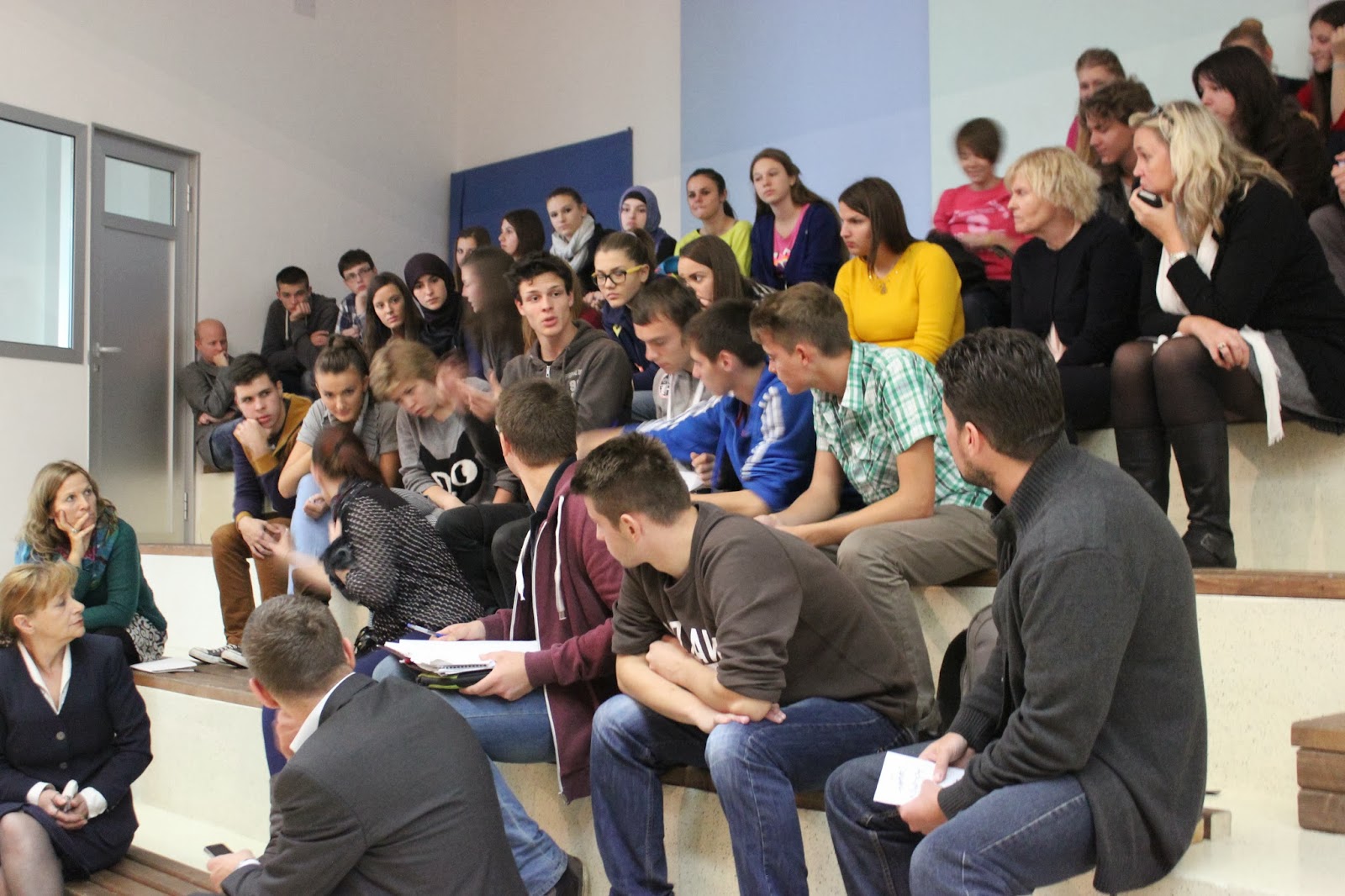
Our last stop was Gimnazija Dobrinja, the upper secondary school we’ve had contact with throughout this project. Last year, four of my students lived with four Bosnian students from this school for a week and it was a great experience for everyone. This time around we teachers had a chance to meet a larger group of students to share how we work with entrepreneurship in our own school. It was interesting to hear these students’ thoughts on education, the job market and the future. The overall attitude is one of skepticism and hopelessness. Statistics communicate that the future is not very bright for many of them. The job market is very limited and it’s extremely difficult for college graduates to get a job within their field of study. 


So what’s the solution? Elvir Resic (to the right of me in the photo), the deputy mayor of Novi Grad (a suburb of Sarajevo), posed the question: ”Would you be willing to take any job, if only to pay the bills while you wait for better employment to eventually present itself?” For a lot of students, this seemed to be a new thought. Eldar challenged them to become volunteers. Very few people are willing to work without pay, so this was a bit provocative. But the truth is you build relationships with people and you start thinking in a different way when you give generously of your time and energy to a cause that benefits a greater community of people. Yet another alternative is to start your own business. That’s where my colleagues and I came in. Since there are so few ready jobs available, the only other good option is to become your own boss, invent a new product, create your own niche. This requires creative thinking and determination to become part of the solution instead of the problem. 


It’s not easy trying to change an entire generation’s outlook on life. Parents pressure their kids to get a good education so that they can get a job. But jobs are scarce, politics are corrupt and change moves at a snail’s pace. I don’t blame young people for growing disillusioned with the dysfunction surrounding them. But I was encouraged by the light I saw in some. These are the future leaders of Bosnia and it’s up to them to choose between being changemakers and forming part of the status quo. 

Exciting times indeed.